Wire EDM is like an invisible knife. It never touches the material, yet it can cut steel into almost any shape using “electric sparks.”
Its full name is Electrical Discharge Machining (Wire EDM). The process uses an extremely thin metal wire—usually molybdenum wire or copper wire, thinner than a human hair. By continuously generating electrical discharges, the metal is gradually “eroded” into the required shape.
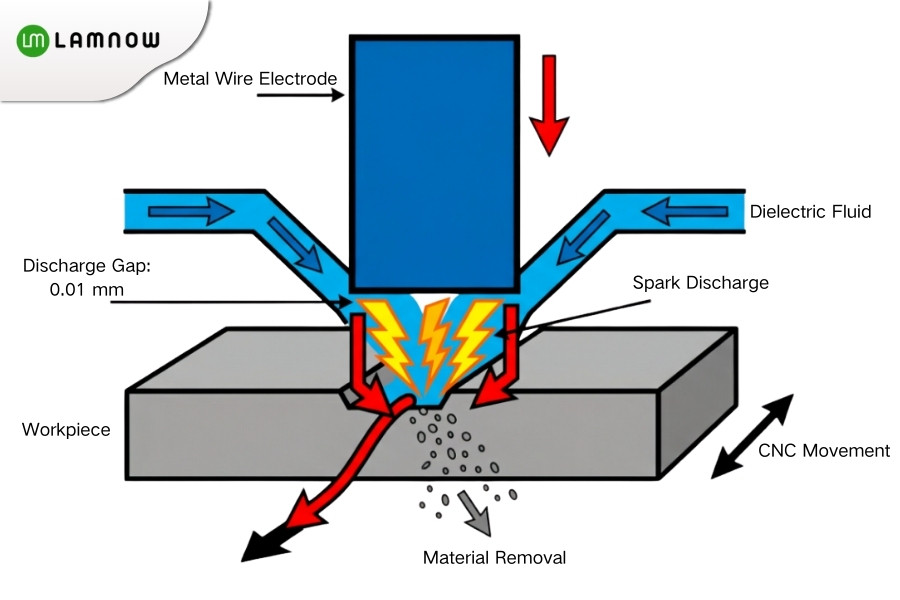
Principle
The wire is kept at a distance of about 0.01 mm from the workpiece.
Thousands of electrical discharges occur every second. Each discharge creates an instantaneous temperature of 10,000–20,000°C, causing the material to locally melt and vaporize. The molten material is then flushed away by the dielectric fluid.
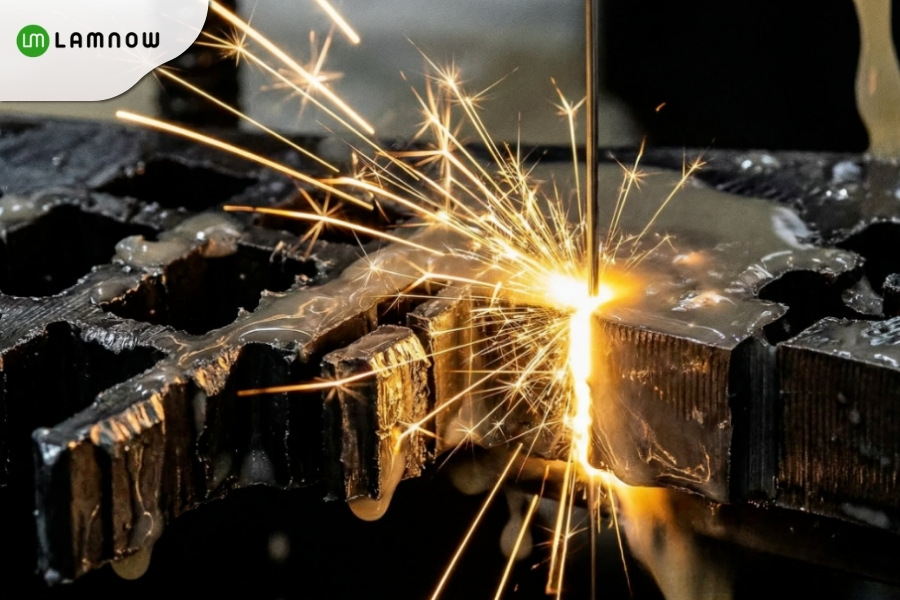
As the wire slowly moves along the programmed path, the metal is cut precisely into shape.
What Are the Differences Between the Three Types of Wire Cutting EDM Machines?
Wire EDM comes in three main types: high-speed wire EDM, medium-speed wire EDM, and low-speed wire EDM.
Although their names seem to refer only to cutting speed, the real differences lie in precision, cost, and application scenarios.

High-speed wire cutting is like a taxi—affordable and practical.
Low-speed wire cutting is like a luxury car—highly precise but expensive.
Medium-speed wire cutting is like a comfortable family car, offering the best balance between performance and cost.
Comparison of Three Types of Wire Cutting Machines
| Comparison Item | High-Speed Wire EDM | Medium-Speed Wire EDM | Low-Speed Wire EDM |
| Wire Speed | 6–10 m/s | 1–3 m/s | 0.001–0.25 m/s |
| Electrode Wire Material | Molybdenum wire (mainstream) | Molybdenum wire (mainstream) | Brass wire (mainstream) |
| Machining Accuracy | ±0.015–0.02 mm | ±0.005–0.01 mm | ±0.002–0.005 mm |
| Surface Roughness | Ra 1.6–2.5 μm | Ra 0.8–1.6 μm | Ra 0.2–0.4 μm |
| Machine Cost | RMB 50,000–150,000 | RMB 100,000–300,000 | RMB 500,000–2,000,000 |
| Machining Efficiency | High | Medium | Low |
| Consumable Cost | Low | Low | High |
| Maintenance Difficulty | Simple | Simple | Complex |
| Maximum Cutting Thickness | ≤ 500 mm | ≤ 400 mm | ≤ 300 mm |
| Typical Applications | Mold roughing, low-precision parts | Medium-precision molds, general-purpose parts | Aerospace, medical devices, high-precision motor laminations |
| Typical Products | General stamping dies, mechanical parts | Plastic molds, hardware molds | Precision connectors, mobile phone molds, high-end motor stator laminations |
Why Are Motor Lamination Core Cut by Wire Cutting?
Motor cores are made from silicon steel laminations—thin, brittle, and magnetic materials that are difficult to machine.
Stamping
Stamping requires dedicated tooling, with long lead times (from several weeks to months) and high costs (tens of thousands to hundreds of thousands). Any design change means a new die must be made.

Laser Cutting
The high heat generated during laser cutting alters the magnetic properties of silicon steel, which negatively affects motor efficiency.

Wire Cutting
Wire cutting requires no tooling, delivers high precision, and does not damage the material. For these reasons, it has become the preferred solution for motor core prototyping and small-batch production.
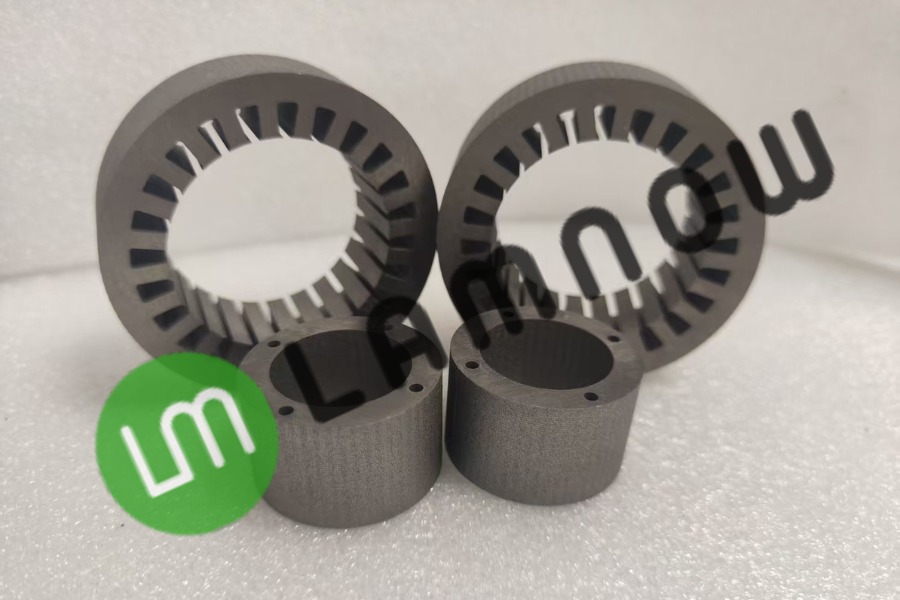
Advantages of Wire EDM in Motor Core Manufacturing
Wire EDM easily handles complex geometries—such as slot teeth, irregular slots, and curved profiles—that are difficult or even impossible to achieve with traditional machining methods.
The process introduces almost zero mechanical stress, as there is no cutting force. As a result, thin-walled and slender parts do not deform during machining.
From CAD drawings to finished samples, the entire process can take only a few hours to a few days.
Most importantly, Wire EDM allows precise control of the air gap, ensuring uniform air gaps after lamination stacking. This directly helps reduce magnetic losses and improve motor efficiency.
Wire Cutting VS Stamping
| Comparison Item | Wire EDM | Stamping |
| Machining Accuracy | ±0.002–0.01 mm | ±0.05–0.1 mm |
| Surface Quality | Ra 0.2–2.5 μm, smooth finish achievable | Burrs present, post-processing required |
| Complex Shapes | Any shape, including internal holes and irregular slots | Limited by tooling, complex shapes are difficult |
| Development Lead Time | A few hours to a few days | A few weeks to several months (die fabrication) |
| Cost for Small Batches | Low (no tooling required) | High (tooling cost amortized over small quantities) |
| Efficiency for Mass Production | Slow (tens of parts per hour) | Fast (tens to hundreds of parts per minute) |
| Design Changes | Program modification only, completed in minutes | New tooling required, high cost |
| Typical Applications | R&D prototypes, small batches, complex geometries | High-volume production, simple geometries |
Selection Recommendations
R&D stage and prototype production: Wire EDM
Small-batch production (tens to hundreds of parts): Wire EDM
Complex geometries and high precision requirements: Wire EDM
Large-scale mass production: Stamping
Wire EDM is the fast track that turns motor stator and rotor core designs from drawings into physical parts, freeing innovation from the long lead times of tooling.
Lamnow provides wire cutting rotor and stator lamination
At Lamnow, we provide high-precision wire-cut stator and rotor laminations for motor prototyping and small-batch production. From complex slot geometries to tight air-gap control, our wire EDM process ensures accuracy, consistency, and preserved magnetic performance.

If you are developing a new motor design or need fast, tooling-free lamination samples, contact Lamnow today. Share your drawings, and our engineering team will help turn your design into high-quality motor cores—quickly and reliably.